It is elections in Singapore this week-end. And it is also '' I will sue you'' time. The oppostiion talks and the Lees filed lawsuits against them. It is normal in modern, sophisticated and westernised Singa-po-rah.
Once again the mighty Lee Kuan-yew is in charge. In the early days of the tiny island republic, he was at the steering wheel as the prime minister, after handing over the baton to his prodigy Goh Chok-tong, he was holding the big stick as senior minister and now, when the baton is held by his son, Hsien-loong he is holding a cane and a big stick as minister mentor - what will he think of next.
Why...? Because he is the super-power in Singapore and is the one firmly in-charge.
That reminds me of a story told some years back when I was residing on employment pass in Singapore. It goes like this.
An American tourist was visiting a temple in Singapore's China Town when he noticed two statues of a man and a woman by the altar.
He asked the monk what was the significance of the two. The monk explained that in Chinese system of 'yin' and 'yang', positives must always be balanced by negatives, and having the two statues ensured that the universal balance was maintained.
'This statue of the woman is the Goddess of Mercy, or Kuan-yin,' the monk said.
'What about the other one?' asked the tourist.
In a hushed voice, the monk said: 'This one is the God of No Mercy.'
'What do you call him in Chinese?' asked the tourist.
The monk looked around and quietly replied 'Kuan-yew'.
Now you know why Singapore is such a 'fine' city state.
Malaysians should have the services of some one like the God of No Mercy to preserve and protect out natural resources such as the rain-forests, the rivers, the hills, the mangroves and the entire environment.

KUDA RANGGI - You can take a horse to (the) water but you can't make it drink.

Sunday, April 30, 2006


Saturday, April 29, 2006
US-led war against terror creates terror
The American-led war against terror has not only fallen far short of its objectives but has also fuelled terror across the globe. The reason that the US-led fight against what it termed as 'terrorism' has made little headway despite having spent more than four years and tens of billions of dollars around the world is that the strategy behind the campaign failed to add the human element to their calculations.
Poverty, unemployment and frustration stemming from denial of social justice are some of the reasons that lead to senseless actions that caused terror and chaos. The world was much safer before George W. Bush unilaterally decided to attack, destroyed and occupied Iraq with the support of his English poodle Tony Blair and later his Australian wallaby John Howard.
Before the US-led occupation, Iraqis were blessed with ample fresh water, enough food, electricity, fuel, freedom (yes with some restrictions), education and law and order. Look at present-day Iraq... this is what the promised freedom and democracy is all about if it was forced upon you by superbullies like the US and its so-called allies.
Poverty, unemployment and frustration stemming from denial of social justice are some of the reasons that lead to senseless actions that caused terror and chaos. The world was much safer before George W. Bush unilaterally decided to attack, destroyed and occupied Iraq with the support of his English poodle Tony Blair and later his Australian wallaby John Howard.
Before the US-led occupation, Iraqis were blessed with ample fresh water, enough food, electricity, fuel, freedom (yes with some restrictions), education and law and order. Look at present-day Iraq... this is what the promised freedom and democracy is all about if it was forced upon you by superbullies like the US and its so-called allies.
Friday, April 28, 2006
Dr M and the bridge that fails to stand
I do not understand why former Prime Minister Tun Dr Mahathir Mohamad goes all out to defend his decision, I mean 'his decision' because it was agreed unanimously by his Cabinet, to replace the Causeway with a bridge. Most of the ministers who had agreed to the project are now serving under present PM Abdullah Badawi and did an about turn to support Abdullah's decision to cancel the project.
In the Mahathir era, it was Mahathir's decision which would be endorsed by the Cabinet. You can say it is a 'Yes Sir Cabinet! It is more or less the same Cabinet and are they dancing to the tune of Cinta Sayang or Boria Kepala Batas.
Mahathir's spat with the government, the same government now led by his appointed successor, is over the government's decision to scrap the building of a bridge to replace the Causeway. But why? Is it because of self reputation, dignity or recalcitrant?
For what ever reasons, the government's decision, whether you like or not, should be respected. I salute Abdullah for the wise decision to scrap the project, after getting the proper legal advice from the Attorney General's Department. Mahathir should respect the decision and stop interfering.
I will not go into details out of respect for Dr Mahathir. I do not like what is going on. Others are laughing at us.
In the Mahathir era, it was Mahathir's decision which would be endorsed by the Cabinet. You can say it is a 'Yes Sir Cabinet! It is more or less the same Cabinet and are they dancing to the tune of Cinta Sayang or Boria Kepala Batas.
Mahathir's spat with the government, the same government now led by his appointed successor, is over the government's decision to scrap the building of a bridge to replace the Causeway. But why? Is it because of self reputation, dignity or recalcitrant?
For what ever reasons, the government's decision, whether you like or not, should be respected. I salute Abdullah for the wise decision to scrap the project, after getting the proper legal advice from the Attorney General's Department. Mahathir should respect the decision and stop interfering.
I will not go into details out of respect for Dr Mahathir. I do not like what is going on. Others are laughing at us.
MALAYSIANS ARE NOT MATURE IN THINKING, SAYS ZAM
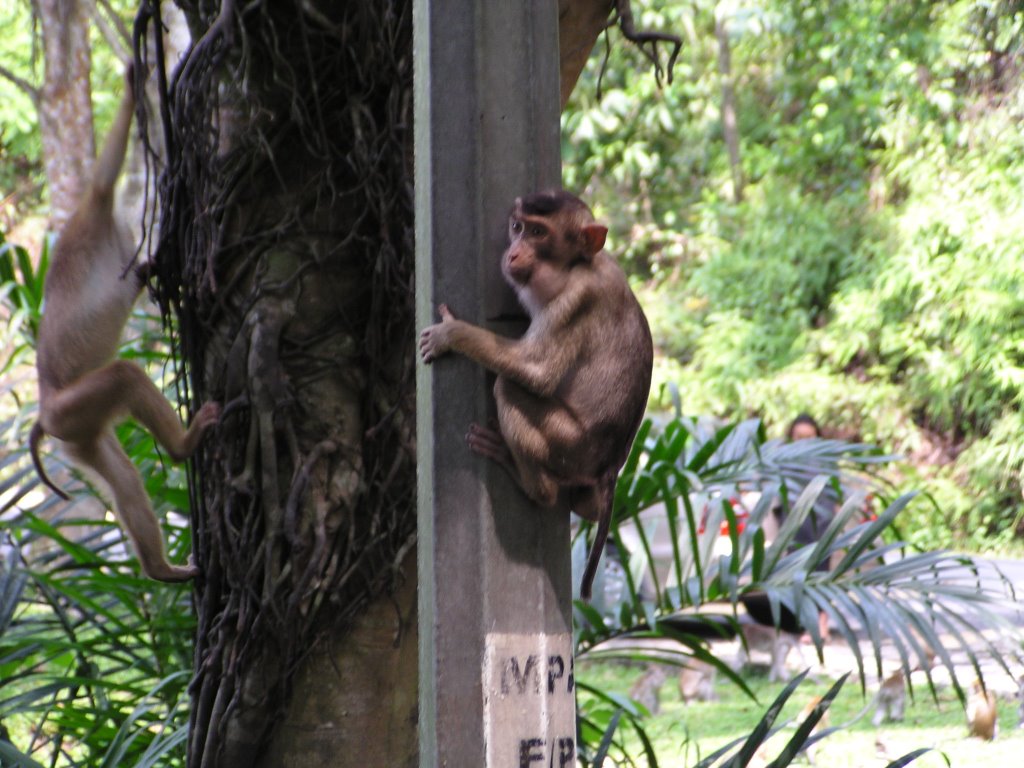
(The lamp-post climbing pig-tailed macaque is, hopefully, mature enough to realise the danger of doing so!)
Information Minister Zainuddin Maidin says the thinking of Malaysians had yet to reach the level of maturity as those in the West. So, it is not the time yet to invite oppostition Members of Parliament (MPs) to give their views on the national tube.
'It is a long way to go, it is not the time yet. We have to democratise them first, then only they will not think in terms of race,' he said when winding-up the debates on the Ninth Malaysia Plan for his ministry in Parliament today (Thursday, 27 April).
Teresa Kok, the Democratic Action Party (DAP) representative for Seputeh constituency complained that Radio-Television Malaysia's 'Parlimen Hari Ini' programme on RTM1 had only invited government MPs to give their views.
'Our speeches are not quoted or aired. That is why many people do not watch (view) RTM programmes. It is biased. It is a government organ. It should take the example of BBC, a television station which belongs to the government but still respects the principle of democracy,' said Kok.
However, ex-journalist Zainuddin or ZAM, replied that Malaysians were still thinking a lot along racial lines, unlike the audience in the UK (United Kingdom) or Europe.
What can I say..., I am ashamed to be told by none other than the information minister, who I believed is well informed, that I am still not as mature in thinking as those in the West. I say 'I' because if a man who is 57 years old is not yet mature, what about those who are much younger, nearly half the population of Malaysia.
When are we going to grow up and face the reality of life, I would say political reality....hopefully it is not too late.
Friday, April 21, 2006
Memories of Penang's Malay Town
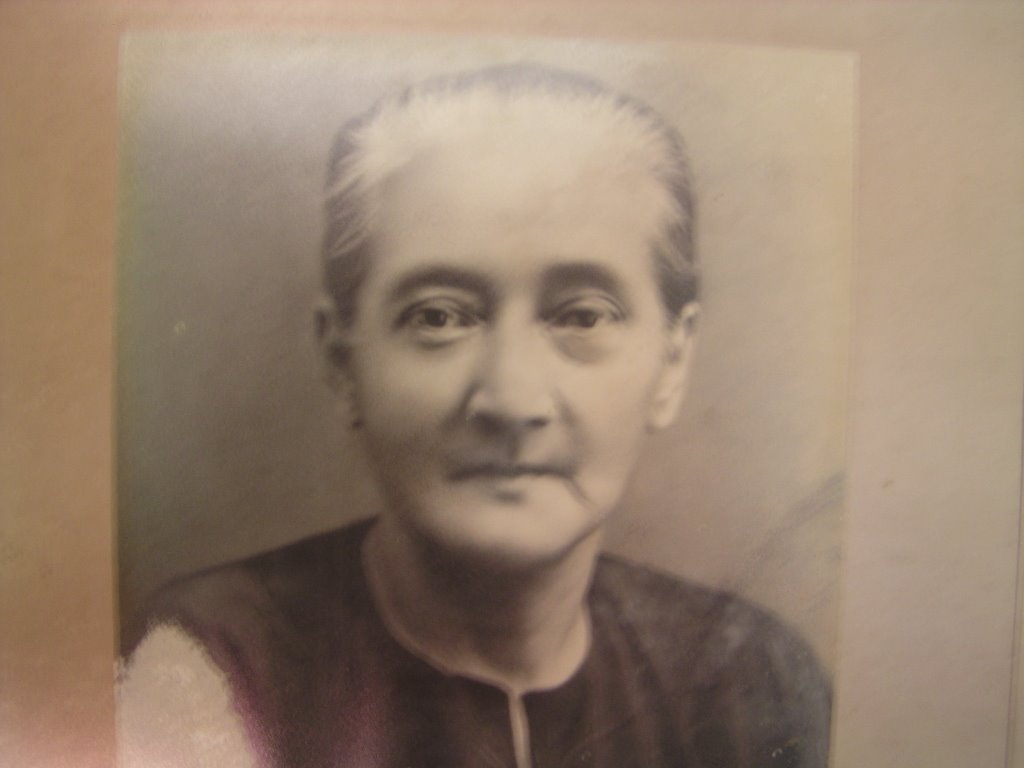
(PIX: Sharifah Salmiah binti Syed Ali bin Syed Abdul Hamid bin Syed Abdul Rahman bin Tengku Syed Hussein Idid (1873-1958)- great grand-daughter of the founder of Malay Mosque, Acheen Street, Penang and great grand-mother of the Blogger).
When Capt Francis Light of the East India Company (EIC)set up the first British trading post in the Far East, that is in Penang in 1786, he wooed Tengku Syed Hussein Idid, an Arab from Aceh, to move to Penang to help spur on the island's economic growth.
Tengku Syed Hussein was the grandson of the Sultan of Aceh and a successful and influential trader. Syed Hussein set up his trading post and settlement fronting the sea. The settlement was recognised as the first township in Penang and was referred to as the Malay Town or Malay enclave.
His standing as a seasoned trader with a vast trading network influenced others, especially Arabs in the Malay archipelago, to migrate to Penang. By 1803, the Malay Town covered Acheen Street (Lebuh Aceh), Malay Street, Armenian Street and parts of Carnavon Street and Beach Street.
Syed Hussein and his clan moved to Penang in 1792 and Francis Light granted him exemption from English laws. It was recognised as the first instance that the colonial administration allowed the Muslim community in the Malay peninsula to practice the Islamic Law (Sharia) but with a condition that no capital punishment should be imposed. Aceh continued to be the source of much Arab immigration to Penang, which accelerated during the 19th century disturbances there.
By his will dated 1820, Syed Hussein created the wakaf for the Malay Mosque or Masjid Melayu which was constructed around 1800. The land comprises Lot 200 Town Subdivision XXII. Apart from the mosque, a total of 16 houses were erected namely houses nos 103, 105, 107, 113, 115 and 117 Chulia Street and nos 49, 55, 57, 59, 77, 79, 81, 81A, B and C Acheen Street. During the Aceh wars of 1870s, the Malay Mosque became one of the focal points of the resistance against the Dutch.
Syed Hussein was also responsible for the construction of Penang's tallest building (at that time and for several decades) - a four-storey house-cum-godown at the junction of Beach Street and Acheen Street, later known as Gedung Aceh, a local landmark which still stands today and referred to as "Rumah Tinggi" or Tall House.
The surrounding area of the Malay Mosque became the Arab quarter in Georgetown and remained so until the mid-20th century. The well known Islamic educational institution, Madrasatul Mashoor Al-Islamiah was established at the Arab quarter in 1916, then known as Madrasatul Al-Quran and its first teacher was Syed Abdul Rahman bin Sheikh Alhabshee, an Arab from Solo, Indonesia and father of the late Tan Sri Syed Abbas Alhabshee of Penang.
It was founded by seven Arabs namely Syed Mohdar Aidid, Syed Omar Almahdar, Syed Omar Alsagoff, Sheikh Hassan Albaghdadi, Sheikh Ali Bawazir, Sheikh Zakaria Basheer and Sheikh Muhammad Alhasawi. So, why it was later named "Almashoor" since no one from the Almashoor family was involved in the setting up of the school? Well it was named after Ayid Mashoor by Syed Sheikh Alhadi when he headed the school. Who is Ayid Mashoor? He was Syed Sheikh's father-in-law Syed Ahmad Almashoor, the penghulu of Jelutong and leader of the Muslim community respected by the British colonial masters.
Several years after Malaysia was formed, the school was taken over by the Education Ministry and is known today as Sekolah Menengah (Agama) Almashoor.
Since the early 19th century, Penang has been the transit point for the Haj pilgrimage to Makkah. The management of the pilgrims was started by one Pak Mas'um Mandailing. He was the first pilgrim agent or broker which were referred to as "Sheikh Haji" and the centre was Kampung Melayu Lebuh Aceh (Malay Town). The haj agency business survived up to the 1970s and became history when the government established the Tabung Haji (Pilgrims Fund and Management Board) to handle the annual pilgrimage.
With the demise of the "Sheikh Haji" and the "kapal haji" replaced by passenger jets, Kampung Melayu Lebuh Aceh suffered. One by one, its residents left in search of greener pasteurs.
The Penang State Government is keeping its fingers crossed anxiously awaiting the outcome of its submission to UNESCO to name part of old Georgetown and most of Kampung Melayu Lebuh Aceh as a world heritage.
Thursday, April 20, 2006
Islam is "in perfect dynamism" with democracy
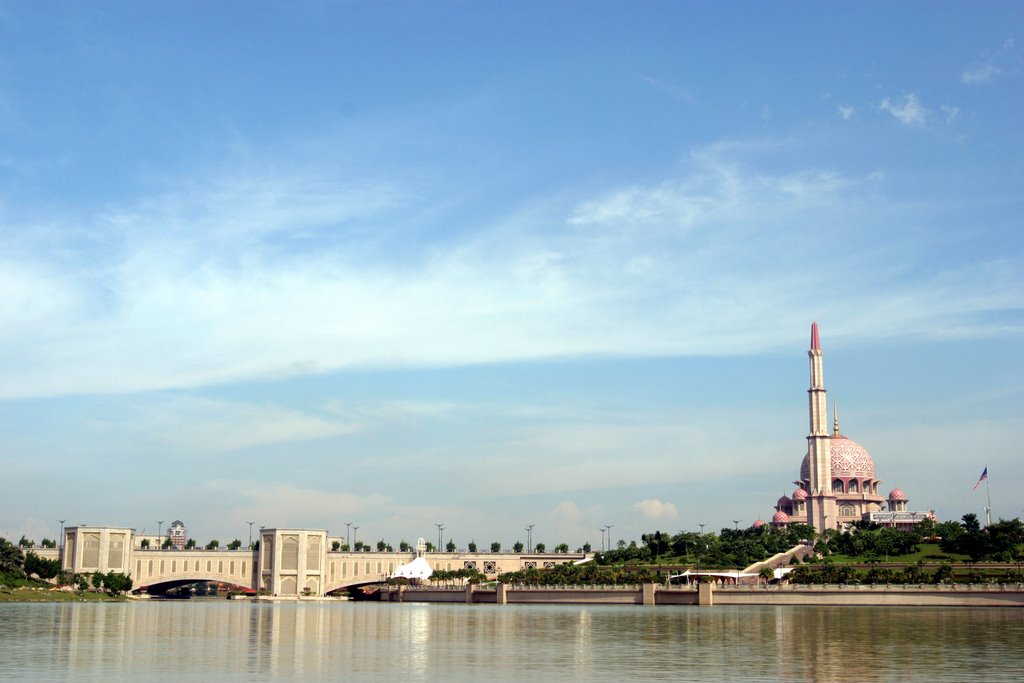
(Pix: Putrajaya Mosque - from across the Putrajaya Lake)
Islam is "in perfect dynamism" with democracy and human rights, according to a recent study conducted for the Dutch government, Zaman Online reported.
After three years of research, the Scientific Council for Government Policy (WRR) in the Netherlands concluded that Islam neither conflicts with democracy, nor human rights nor Dutch values.
The WRR report, titled "Dynamism in Islamic activism", said that European countries must support the Islamic movements that embrace democracy, like the Muslim brotherhood in Egypt and Hezbollah in Lebanon.
It also recommended that Europe communicates with and offers aid to the Hamas-led Palestinian government.
"Contrary to the common belief, Islam has no problem accepting democracy and human rights...Instead of exporting democracy to Muslim countries, democratic attempts harmonious with their own traditions and cultures must be supported," the Council advised European governments in its report.
The study, which also covered the Islamic movement in Europe, said that tensions between Muslim countries and the West are mainly caused by a lack of communication and dialogue.
"This study is indeed a step towards opening a more serious dialogue with Islam and curbing extremism irrespective of its source," said Marzouk Abdullah Awlad, professor of Islamic Studies in the Amsterdam Free University.
"Islam is a religion that interacts with its surrounding environment and adapts with different circumstances with no complications," he added.
Wednesday, April 19, 2006
The concept of Islam Hadhari is not new
Islam Hadhari, introduced by Malaysian Prime Minister Abdullah Badawi as an approach that emphasises development, consistent with the tenets of Islam and which focused on enhancing the quality of life, is not something new.
A similar approach was introduced some 600 years ago by Wali al-Din Abdal Rahman bin Mohamad bin Abi Bakar Mohamad bin al-Hassan or better known as Ibn Khaldun, one of the most prominent figures of Arab-Muslim culture.
Ibn Khaldun, universally recognised as the founder and father of Sociology and Sciences of History, wrote about it in his most famous work "Muqaddimah" or "Prolegomena".
Here in Malaysia, Abdullah said his concept aims to achieve its targets via the mastery of knowledge and the development of the individual and the nation; the implementation of a dynamic economic, trading and financial system; an integrated and balanced development that creates a knowledgeable and pious people who hold to noble values and are honest, trustworthy, and prepared to take on global challenges.
Ibn Khaldun's unique approach and original contribution, which became a masterpiece in literature on philosophy of history and sociology, was aimed at identifying psychological, economic, environmental and social facts that contribute to the advancement of human civilization and the currents of history. In this context, he analysed the dynamics of group relationships and showed how group-feelings, al-Asabiya, give rise to the ascent of a new civilization and political power and how, later on, its diffusion into a more general civilization invites the advent of a still new "Asabiya in its pristine form. He identified an almost rhythmic repetition of rise and fall in human civilization, and analysed factors contributing to it.
Unlike most earlier writers interpreting history largely in a political context, Ibn Khaldun's emphasised environmental, sociological, psychological and ecoomic factors governing the apparent events. All these were written 600 years ago by this great man born in Tunisia in 1332 C.E.
Ibn Khaldun's great contributions in history, philosophy of history, sociology, political science and education have remained dominant and significant ever since his life. His books have been translated into many languages, both in the East and the West, and have inspired other figures to develop these sciences and add to them.
Abdullah's principles of Islam Hadhari namely faith and piety in Allah; a just and trustworthy government; a free and independent people; mastery of knowlkedge; balanced and comprehensive economic development, a good quality of life; protection of the rights of minority groups and women; cultural and moral integrity; safeguarding the environment; and strong defences -- all if not most of them - were mentioned in Ibn Khaldun's "Muqaddimah".
A similar approach was introduced some 600 years ago by Wali al-Din Abdal Rahman bin Mohamad bin Abi Bakar Mohamad bin al-Hassan or better known as Ibn Khaldun, one of the most prominent figures of Arab-Muslim culture.
Ibn Khaldun, universally recognised as the founder and father of Sociology and Sciences of History, wrote about it in his most famous work "Muqaddimah" or "Prolegomena".
Here in Malaysia, Abdullah said his concept aims to achieve its targets via the mastery of knowledge and the development of the individual and the nation; the implementation of a dynamic economic, trading and financial system; an integrated and balanced development that creates a knowledgeable and pious people who hold to noble values and are honest, trustworthy, and prepared to take on global challenges.
Ibn Khaldun's unique approach and original contribution, which became a masterpiece in literature on philosophy of history and sociology, was aimed at identifying psychological, economic, environmental and social facts that contribute to the advancement of human civilization and the currents of history. In this context, he analysed the dynamics of group relationships and showed how group-feelings, al-Asabiya, give rise to the ascent of a new civilization and political power and how, later on, its diffusion into a more general civilization invites the advent of a still new "Asabiya in its pristine form. He identified an almost rhythmic repetition of rise and fall in human civilization, and analysed factors contributing to it.
Unlike most earlier writers interpreting history largely in a political context, Ibn Khaldun's emphasised environmental, sociological, psychological and ecoomic factors governing the apparent events. All these were written 600 years ago by this great man born in Tunisia in 1332 C.E.
Ibn Khaldun's great contributions in history, philosophy of history, sociology, political science and education have remained dominant and significant ever since his life. His books have been translated into many languages, both in the East and the West, and have inspired other figures to develop these sciences and add to them.
Abdullah's principles of Islam Hadhari namely faith and piety in Allah; a just and trustworthy government; a free and independent people; mastery of knowlkedge; balanced and comprehensive economic development, a good quality of life; protection of the rights of minority groups and women; cultural and moral integrity; safeguarding the environment; and strong defences -- all if not most of them - were mentioned in Ibn Khaldun's "Muqaddimah".
Subscribe to:
Posts (Atom)